

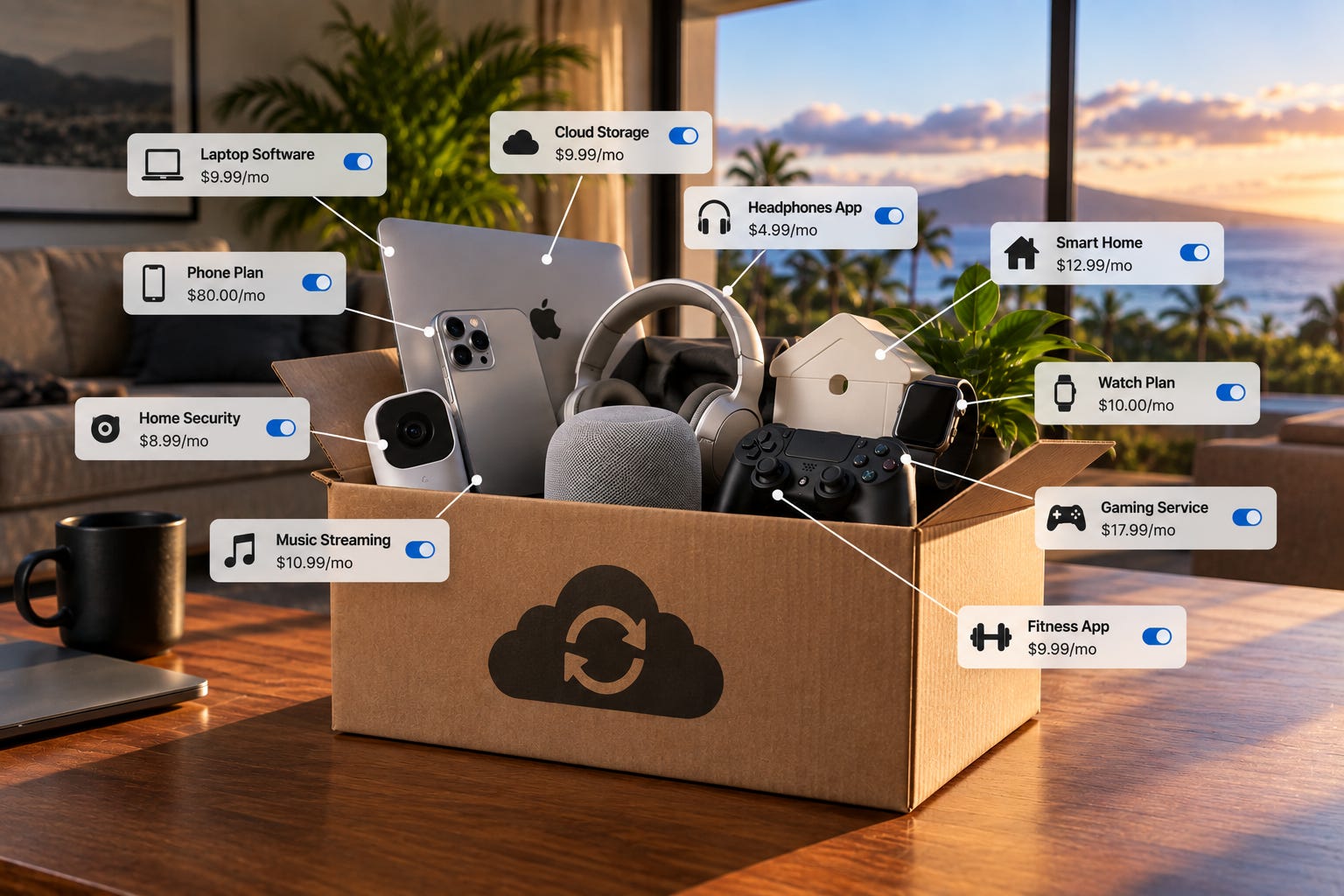
I was going through my Verizon bill recently, trying to figure out exactly what I was paying for and whether I could consolidate it without giving something up. Somewhere in the process I came across yet another feature available for another monthly charge.
The amount itself was trivial. What bothered me was the familiarity of it. It seems like everything now comes with a monthly fee attached.
I pay Apple every month for storage. I pay Google every month for my security cameras. I recently bought a used Eight Sleep system, only to discover that some of the intelligence that makes the thing interesting requires a subscription. Software I once would have purchased now generally requires a monthly or annual payment. Streaming services have multiplied to the point where replacing cable with streaming can involve half a dozen separate bills.
None of these expenses is particularly outrageous on its own. That’s probably why the model works so well. But I started wondering what happens if we keep going in this direction.
Does everything eventually become a subscription?
It’s an especially strange question to consider at this particular moment because technology seems to be pushing us in precisely the opposite direction.
Things should be getting cheaper
One of the recurring themes I’ve been thinking and writing about is the possibility of abundance.
AI is already making certain kinds of intellectual work dramatically less expensive. Robotics should eventually do something similar for physical labor. Add increasingly cheap energy, automated manufacturing, better materials and recycling, and it’s not difficult to imagine the actual cost of producing many goods and services falling substantially over the next decade or two.
That’s not a particularly radical prediction. Technology has been doing this for a long time.
Computing is the obvious example. The amount of computing power and storage available to an ordinary person today would have been unimaginably expensive a few decades ago. Communication that once cost dollars per minute can cross the planet essentially for free. A phone in your pocket replaced a camera, GPS receiver, music player, calculator, flashlight, encyclopedia and quite a few other things people once bought separately.
AI and robotics could extend that process much further. If machines eventually perform a large percentage of both intellectual and physical labor, labor stops being the major component of the cost of many things.
That line of reasoning is what led me to write about post-scarcity in the first place.
But the Verizon bill made me notice another possibility I hadn’t thought much about.
What if the cost of producing things keeps approaching zero, but the cost of accessing them doesn’t?
We used to buy things
I remember buying software in a box.
You paid for it once, installed it on your computer and used it until you decided there was enough value in the next version to buy it again. The software company had to convince you that the upgrade was worth paying for.
Subscriptions changed that relationship.
For businesses, the appeal is obvious. Selling something once produces revenue once. Turning the same customer into a subscriber produces predictable revenue every month, potentially for years. Investors like predictable recurring revenue, companies like it, and apparently consumers will tolerate quite a lot of it.
So the model spread well beyond software. Music, movies, news, cloud storage, security systems, exercise equipment and increasingly the capabilities of physical products themselves can all require ongoing payments.
In many cases, subscriptions make perfect sense. Spotify has to license music and operate a service. Cloud storage requires infrastructure. Software that is continuously being developed has ongoing costs. I’m not arguing that subscriptions are inherently bad.
What interests me is what happens when the model becomes the default.
There is a meaningful difference between buying something and buying continued permission to use something. Ownership eventually reaches an endpoint. You pay for the television, bicycle, camera or computer and then, barring maintenance, you’re finished paying for it.
A subscription has no endpoint.
A strange version of abundance
Imagine a household twenty years from now.
Robotic factories manufacture products using very little human labor. Energy is dramatically cheaper. Materials are efficiently recovered and recycled. Transportation and distribution are largely automated. The actual marginal cost of producing many household products might be extraordinarily low.
You might expect that household to be surrounded by things that cost very little.
Maybe it will be.
But it’s also possible that the refrigerator has a service plan. The household robot has one. The car requires connectivity. The home security system has a subscription. The AI running much of the household has several service tiers. Medical monitoring, entertainment, communications, software and automated services all arrive as small recurring charges.
Nothing seems expensive. It’s $8 here, $15 there, $30 somewhere else.
Yet the household needs thousands of dollars every month simply to keep everything turned on.
That’s an odd kind of abundance.
We would have solved much of the technological problem of scarcity while preserving scarcity economically through control of access.
Scarcity doesn’t have to mean running out of something
This is one of the things the digital economy has made particularly clear. Scarcity can exist even when supplying one additional customer costs almost nothing.
A software feature can already exist on a device you own and remain unavailable until you pay to activate it. The additional cost to the manufacturer of letting you use that feature may be effectively zero. What you’re paying for isn’t production. You’re paying for permission.
Again, that doesn’t automatically make the arrangement unreasonable. Someone paid to develop the software. Companies need to make money, and intellectual property has value even when reproduction is cheap.
But carried far enough, it changes the nature of ownership.
A person can own a house filled with sophisticated technology while having surprisingly little permanent access to the capabilities inside it.
And that becomes much more consequential when income is interrupted.
In an ownership-heavy economy, losing your job means you stop buying new things, but most of the things you already purchased continue working. Your television still turns on. Your tools are still in the garage. Your car still drives. Your music collection doesn’t disappear.
In a heavily subscription-based economy, financial trouble could progressively shut down pieces of your life. One service expires, then another, then another.
You don’t necessarily lose your possessions. You lose what they can do.
AI makes the contradiction harder to ignore
This is where the question connects back to the larger technological transition.
AI may make enormous amounts of intellectual labor inexpensive enough that services once available primarily to businesses or wealthy individuals become accessible to almost everyone. Personalized tutoring, sophisticated financial analysis, software development, research, design and other expertise could become extremely cheap.
Robotics could eventually bring the same economics into the physical world.
If that happens, it should create an extraordinary amount of abundance. But I’ve probably been too quick to assume that falling production costs necessarily translate into falling costs for consumers.
They often do, especially when competition is strong. But they don’t have to.
If a small number of companies control the systems producing that abundance, the important economic question may not be how cheaply something can be produced. It may be how much people are willing to pay for access to it.
In other words, a world capable of producing abundance isn’t necessarily the same thing as a world in which abundance is broadly available.
You can put a tollbooth in front of something that is plentiful.
Maybe the model eventually breaks
There are good reasons to think this won’t continue indefinitely.
When technologies mature and competitors multiply, margins tend to collapse. Open-source AI can compete with subscription services. Household robots could eventually become appliances you simply own. Distributed energy may allow people to produce more of their own power. Manufacturing itself may become smaller, cheaper and more local.
Consumers also have limits. There are only so many recurring charges people can absorb before they begin actively avoiding them.
So perhaps the proliferation of subscriptions is just a feature of this stage of the technological transition. Companies have discovered an extremely effective business model, and they’re applying it everywhere they can until competition or consumer resistance forces something different.
I don’t know.
But that’s what struck me while staring at a cellular bill and wondering why yet another feature needed its own monthly charge.
I’ve been thinking about a future in which technology makes scarcity less important. At the same time, I’m watching the present economy become increasingly good at turning ownership into access and access into recurring revenue.
Those two trends don’t fit together as neatly as I had assumed. The question isn’t really whether another $10 subscription is affordable.
It’s what happens when nearly everything is.