

When I was a kid, my brain was a sponge. I couldn’t absorb enough information about the world around me. I remember spending hours reading the almanac, fascinated by countries I’d never visited, their populations, geography, economies, and how people lived in places so different from my own. I wanted to understand everything.
We had a set of encyclopedias at home, too. They were probably 15 years old, and even when they were new, much of the information was already dated. But that was what we had. If you wanted to learn something, you looked it up, went to the library, or asked someone who might know. And if the information wasn’t available, well, you simply didn’t know.
Compare that to today.
Just this week, NASA confirmed that Voyager 1, launched nearly 50 years ago, had reached a distance of one light-day from Earth. That’s more than 16 billion miles. A signal traveling at the speed of light now takes 24 hours to reach us from a spacecraft we launched in 1977.
And I learned about it while scrolling through my phone.
Think about that for a moment. We’re receiving information from a machine traveling through interstellar space, while sitting on our couches, drinking coffee, and casually browsing the news. Meanwhile, events unfolding halfway around the planet can reach us within seconds of happening.
For most of human history, this would have been unimaginable. Today, we barely give it a second thought.
But there’s something much more profound happening here than simply having better technology.
For the first time in human history, information is becoming extraordinarily difficult to contain. And I’m not sure we’ve fully considered what that means.
Knowledge Has Always Been Power
Throughout history, information has been one of the most valuable instruments of control.
Kings, emperors, religious institutions, and ruling classes understood something fundamental: those who controlled what people knew could influence what people believed. And those who influenced what people believed could shape how they behaved.
Information wasn’t necessarily meant to be shared. It was something to be guarded, interpreted, selectively distributed, and sometimes deliberately withheld.
Of course, there were practical limitations. Before widespread literacy and modern communication, distributing information was difficult and expensive. But those limitations also served the interests of people in power.
As civilization evolved, so did our ability to communicate. The printing press, telegraph, radio, and television progressively expanded the reach of information. News could travel faster and reach more people than ever before.
Yet the underlying structure remained remarkably similar.
Someone still decided what was newsworthy, what deserved attention, which details mattered, and how the story would be told.
That doesn’t mean every journalist, editor, or institution was operating with malicious intent. Many were genuinely trying to inform the public. But the concentration of information in relatively few hands created an extraordinary opportunity to influence public perception.
And influence, whether exercised by governments, corporations, religious institutions, or individuals, has always been valuable.
Control the information, shape the narrative. Shape the narrative, influence the population.
It’s a formula that has worked for centuries.
Then We Opened the Internet
The internet fundamentally disrupted that arrangement.
Suddenly, information no longer needed to pass exclusively through newspapers, broadcasters, governments, or other established institutions. Anyone with a connection could publish, investigate, challenge, or distribute information to potentially millions of people.
And when smartphones arrived, we put that capability in nearly everyone’s pocket.
Consider what that means for a government that depends on controlling what its citizens know.
China’s Great Firewall is a particularly revealing example. By restricting access to foreign websites, social platforms, and politically sensitive information, the Chinese government has constructed an elaborate system designed to control much of the information its population can readily access.
Why go to such extraordinary lengths?
Because unrestricted information creates comparisons. Comparisons create questions. And questions can challenge authority.
When people can see how others live, what freedoms they enjoy, what opportunities exist, and how their governments operate, they gain a perspective that might otherwise have been unavailable to them.
But this isn’t exclusively a Chinese problem, nor is it limited to authoritarian governments.
Even in democracies, information is continuously shaped by political messaging, corporate interests, advertising, media ownership, and increasingly, algorithms that determine what appears on our screens.
The methods differ, but the desire to influence what people see and believe remains remarkably consistent.
And perhaps that’s what makes this moment in history so interesting.
The traditional gatekeepers are losing some of their ability to decide what we get to know.
The Truth Is Complicated
I hear people complain regularly that too many Americans get their news from social media. That information is unverified, that anyone can post anything, and that misinformation spreads faster than facts.
They’re not wrong.
The internet has made it easier than ever to distribute falsehoods, manufacture outrage, manipulate images, and present opinions as established facts. Artificial intelligence is making some of those problems considerably more sophisticated.
But there’s another side to this that I think deserves equal consideration.
For the first time, ordinary people can challenge official accounts with their own evidence. They can share videos from events as they unfold, examine publicly available records, compare statements made by elected officials, and investigate claims without waiting for a journalist or institution to decide the subject is worth covering.
We have independent researchers, citizen journalists, whistleblowers, open-source intelligence communities, and increasingly sophisticated tools capable of examining enormous amounts of information.
And now AI is making that information easier to search, summarize, translate, and understand.
That’s extraordinary.
But access to information and access to truth are not the same thing. More voices don’t automatically produce greater accuracy, and the absence of traditional gatekeepers doesn’t mean we’ve escaped manipulation. Sometimes we’ve simply traded one form of influence for another.
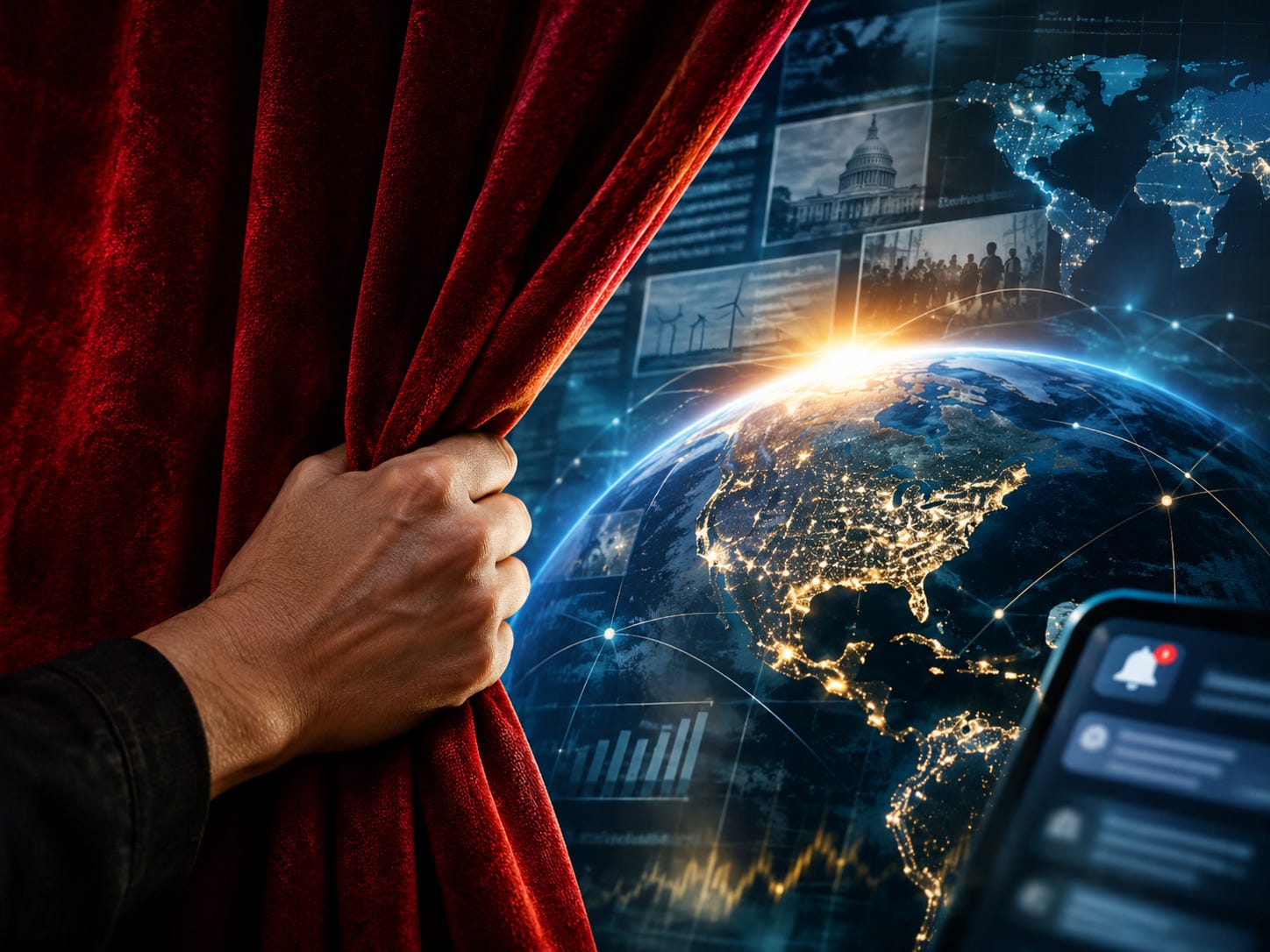
Algorithms can create their own curtains, showing us precisely what keeps us engaged while concealing perspectives that might challenge our beliefs.
The challenge, then, isn’t simply tearing down the old gatekeepers. It’s learning to recognize the new ones, while developing the ability to distinguish evidence from persuasion and facts from fiction.
Still, despite these limitations, something fundamental has changed.
We have more opportunities than ever before to look beyond the version of reality we’re being presented.
And once people begin looking, they sometimes discover things they’d rather not know.
What Happens When We See What’s Behind the Curtain?
This is where my optimism about technology encounters something considerably more uncomfortable.
I’ve always believed that humanity is capable of doing better. Better at living together, better at resolving conflict, better at managing our resources, and certainly better at caring for the planet that sustains us.
We have accomplished extraordinary things. We’ve developed medicine that saves millions of lives, technology that connects continents, and spacecraft that travel beyond the boundaries of our solar system.
We’re even actively contemplating becoming a multiplanetary species.
And yet, here on Earth, we still struggle with some of the most basic responsibilities of civilization.
We wage wars, destroy ecosystems, tolerate enormous suffering, and frequently prioritize short-term advantage over long-term well-being.
Sometimes I wonder whether we shouldn’t get a little better at managing the planet we already inhabit before exporting our behavior to another one.
But I digress.
The point is that greater visibility is exposing not only the remarkable things humanity has accomplished, but also the extraordinary ways we’ve failed one another.
And that creates an uncomfortable dilemma.
It’s relatively easy to live with problems we don’t fully understand, particularly when they seem distant or beyond our control. It’s something else entirely to see the evidence, understand the consequences, and recognize that our own decisions may be contributing to the problem.
Once you’ve seen something clearly, it becomes much harder to pretend it isn’t there.
That realization can be empowering. But it can also be exhausting.
We’re already witnessing widespread frustration with political institutions, economic systems, corporate behavior, and the seemingly endless conflicts that dominate the news.
People are questioning whether the systems they’ve trusted are actually working in their interests.
Some are becoming more engaged. Others appear to be withdrawing, overwhelmed by the scale of problems they feel powerless to change.
It reminds me, at least philosophically, of Ayn Rand’s Atlas Shrugged, in which productive individuals eventually withdraw from a society they no longer believe is functioning properly.
I’m not suggesting we’re approaching that fictional scenario, nor do I necessarily agree with Rand’s conclusions. But the underlying question is worth considering.
What happens when enough people stop believing in the legitimacy of the systems that govern their lives?
And what happens when the information that shapes those beliefs becomes increasingly difficult to control?
Awareness Is Not the Same as Action
This is part of what motivated me to begin working on Collective Signal.
I’ve become increasingly interested in how ordinary people can use readily available information to understand the decisions affecting their communities. Not simply accepting an explanation because it comes from an authority, but examining the underlying numbers, policies, incentives, and consequences.
Transparency shouldn’t be about finding someone to blame. It should be about understanding what’s actually happening well enough to make better decisions.
But I’ve also come to recognize that information alone isn’t sufficient.
We can expose waste, corruption, inequality, environmental destruction, and institutional failures. We can document them, discuss them, share them, and debate them endlessly.
And then what?
There’s a difference between knowing something is wrong and being willing to do something about it.
There’s also a difference between being angry about a problem and understanding it well enough to help solve it.
Perhaps this is the next great challenge of the information age.
For centuries, our greatest limitation was access to knowledge. Today, increasingly, our limitation may be what we choose to do with it.
We have more information available than any generation in human history, yet we still struggle to agree on basic facts, much less on what should be done about them.
And there’s an uncomfortable possibility worth considering: perhaps those in power aren’t the only ones who benefit from keeping certain things behind the curtain.
Perhaps we do, too.
Ignorance can be comfortable. Awareness comes with responsibility. It’s easier to believe that someone else understands the problem, someone else has a plan, and someone else will eventually make things better.
But as access to information expands, that comfortable distance becomes harder to maintain.
So Where Do We Go From Here?
I don’t believe humanity is destined to repeat its mistakes indefinitely.
In fact, much of my optimism about the future comes from the extraordinary capabilities we’re developing. Artificial intelligence, robotics, abundant energy, and increasingly sophisticated technologies could eventually help us address problems that have persisted for centuries.
But technology doesn’t automatically produce wisdom. And visibility doesn’t automatically produce accountability.
Those are choices.
We now have the ability to understand our world with a depth and immediacy that would have seemed almost supernatural to previous generations. We can examine the decisions of our leaders, question long-standing assumptions, compare different approaches to organizing society, and collaborate across borders in ways that were previously impossible.
We are running out of excuses for not knowing.
But knowing is only the beginning.
The curtain is being pulled back, gradually and unevenly, revealing a world that is simultaneously more remarkable and more troubling than many of us imagined.
The question isn’t simply whether we’re ready to see what’s behind it.
It’s whether we’re prepared to accept responsibility for what we find.
Because if we finally have the ability to see what’s wrong with the world, and still choose to do nothing about it, perhaps the greatest obstacle to a better future was never the information being kept from us.
Perhaps it was us all along.
Good ideas are worth sharing. If this article made you think, pass it along to someone who might appreciate a different perspective.
Enjoyed this article? Subscribe to Following the Thread for more perspectives on life, technology, and the world we’re creating. New essays delivered free to your inbox.
Very eloquently stated. Keeping our heads in the sand is a very comfortable place. Now we are running out of sand.
As usual, another profound and thoughtful commentary. You always encourage me to stretch my thinking.