

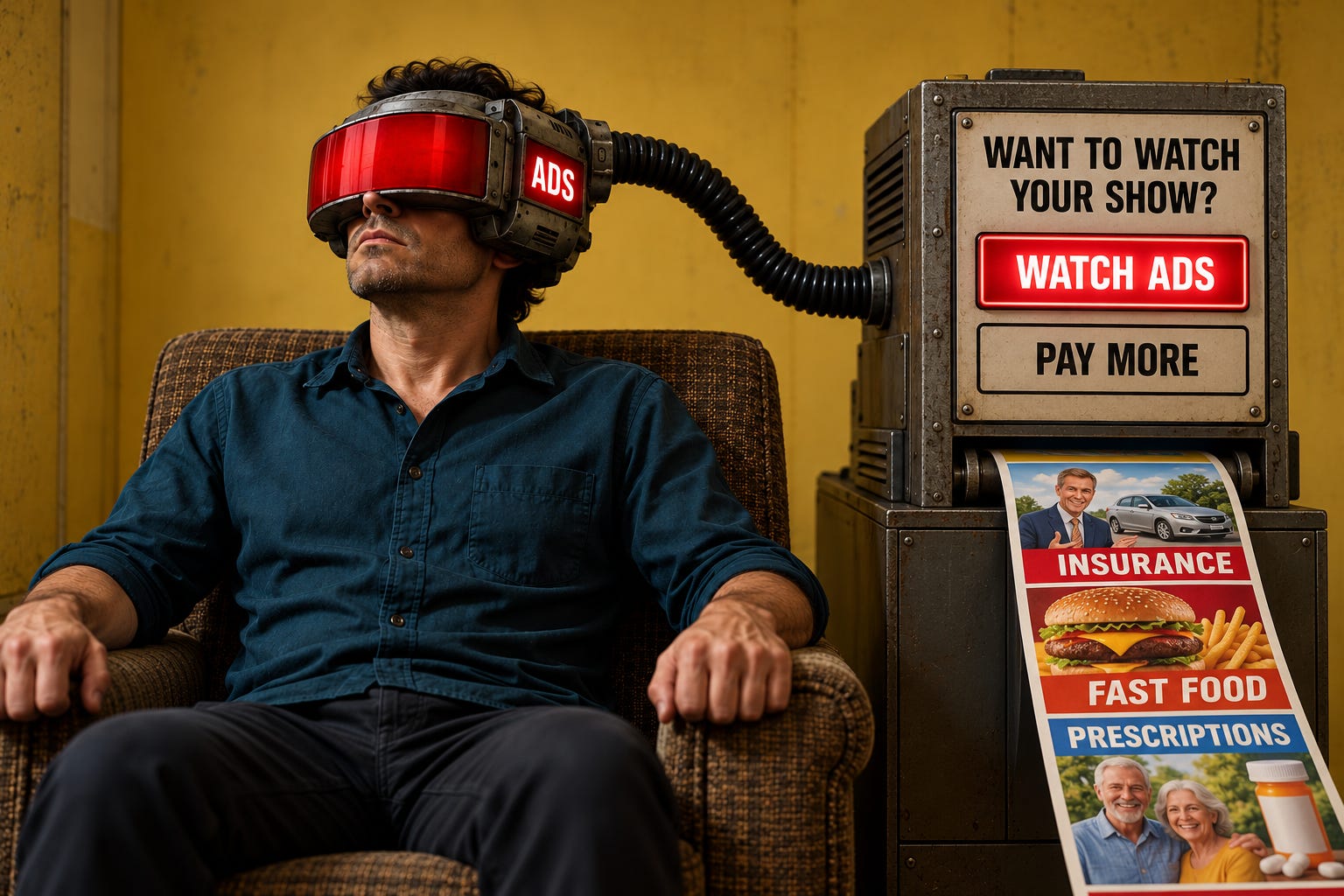
It’s irritating to sit through a commercial. It’s more irritating when I’m paying for the service showing it.
I know producing television is expensive. But I also remember why streaming felt like an improvement. You paid. You chose what to watch. You watched it. No waiting for a channel to show something. No commercial break just as the story got interesting.
Now I wonder what, exactly, the payment covers. And increasingly, I wonder why we keep accepting changes we don’t like.
A company announces new terms. We complain, compare plans, perhaps pay a little more. Eventually, we get used to it. The next change starts from there.
At what point do we stop adjusting our expectations and start withdrawing our money?
It helps to remember how we got here.
On August 28, 1922, New York station WEAF aired a ten-minute paid pitch for apartments in Queens. Real estate. Of course. AT&T, which operated the station, was experimenting with selling airtime. Broadcasting needed a business model, and businesses would pay to reach the people listening.[1][2]
The bargain that developed was straightforward: advertisers helped fund the programming, and listeners supplied their attention. Television carried that arrangement into the living room. You might not have enjoyed the commercials, but you understood why they were there.
Then we found ways around them. A VCR let you fast-forward through recorded ads. TiVo and other DVRs made recording and navigating television more convenient. From the advertiser’s side, avoiding the commercial was a problem. From the couch, it was progress.
Streaming seemed to take the next step. Netflix offered a subscription, a library, and no commercial breaks. The experience felt like something worth paying for. We gained control over both the schedule and the interruptions.
Then the commercials came back.
In November 2022, Netflix introduced a cheaper plan with advertising alongside its existing ad-free plans. That’s a reasonable offer. Some people would rather save the money, and they could choose that trade.[3]
Amazon did something different. In January 2024, it introduced ads into Prime Video movies and shows for U.S. subscribers and offered an additional $2.99 monthly charge to avoid them. About $36 a year to preserve the experience subscribers had previously received.[4]
A company can call that another option. From the customer’s side, it feels like buying back something you were already paying for.
The obvious objection is that subscriptions and advertising have coexisted for a long time. Newspapers did it. Magazines did it. Cable did it. Paying has never universally meant that nobody gets to advertise to you.
Fair enough. But that doesn’t settle the question of whether a particular change is acceptable.
If a service launches with ads, I can decide whether the trade is worthwhile. If the price rises, I can weigh the higher price. When a service I already use adds interruptions and charges me to remove them, I have to reconsider an arrangement I thought I’d already made.
I understand the business logic. Content costs money. Growth matters. A company that can collect subscription revenue and advertising revenue has a reason to pursue both.
Understanding the incentive doesn’t obligate me to accept the result.
Yet accepting it is often what we do.
A few extra dollars seem easier than canceling. The new season is coming. Someone else in the household watches it. The service is bundled with something useful. Finding an alternative means another search, another account, another password, and possibly the discovery that the alternative has its own irritating terms.
Sometimes the switching costs are substantial. Sometimes we’re exhausted. And sometimes, if we’re honest, we just can’t be bothered.
I recognize that impulse. I can be annoyed by the interruption and still want to watch the show more than I want to deal with the subscription.
That is an understandable decision. It also has consequences.
A company can hear a great deal of dissatisfaction while continuing to receive the same payments. If enough customers stay, the change may work commercially even when it makes the experience worse for them.
Our objection and our payment tell two different stories. One says we dislike the arrangement. The other says we’re still willing to buy it.
Calling this corporate greed expresses the frustration. But the part we can influence is what we continue to reward.
I keep thinking about that video of a plastic straw being pulled out of a sea turtle’s nose.
In 2015, marine biologist Christine Figgener filmed her research team removing the straw from a turtle off Costa Rica. The video spread around the world and helped galvanize a movement against single-use plastic straws.[5]
People had heard about ocean pollution before. This made it visible in a way that was difficult to dismiss. A disposable object used for a few minutes was lodged in a living animal’s nose. You could see the connection between an ordinary habit and a consequence normally out of sight.
In July 2018, Starbucks announced plans to phase out single-use plastic straws globally by 2020, using strawless lids and alternative materials. It was part of a broader movement involving campaigners, businesses, and governments. The video didn’t single-handedly cause every change that followed, and the transition wasn’t instantaneous.[6]
Still, it showed how a familiar practice could suddenly become something people expected companies to change.
A commercial interruption is obviously not equivalent to an injured animal. The connection is in how people respond: something widely tolerated becomes unacceptable, people make that objection visible, and businesses face pressure to respond.
That movement wasn’t simply a boycott, and it didn’t solve plastic pollution. What stays with me is the reminder that habits and business practices can change when enough people stop treating them as inevitable.
Why do we so often forget that in other parts of our lives?
We have become very good at adapting to decisions we had no part in making.
A service changes its terms, and we search the new plans for the least irritating option. We ask which tier to buy, which bundle to choose, how much more to pay. The company sets the choices, and we spend our energy finding our place among them.
But who decided those were the only choices?
Canceling is a choice. Refusing the new terms is a choice. Organizing other customers around the same refusal is a choice. Those options can disappear from the conversation when we become accustomed to treating every announcement as something we simply have to accommodate.
This is what bothers me beyond the commercials. We are people with judgment, preferences, and the ability to act together. Yet we can fall into behaving like a predictable flow of payments: redirect us here, add a charge there, introduce another interruption, and most of us will continue along the path.
We should be uncomfortable with how dependable that behavior can become.
A company doesn’t need us to like every change. It needs enough of us to keep paying. When we make staying the reliable outcome, we give it room to keep testing how much more we will tolerate.
The turtle video offers a different picture of the public. People saw something they would no longer dismiss, shared it, and helped make a familiar business practice a public issue. An objection that might have remained private became something companies were expected to answer.
We need more of that willingness to act together.
Millions of people can dislike the same practice and still exert very little pressure if each person assumes everyone else will continue accepting it. We remain separate customers making separate calculations. A company can deal with those departures as ordinary turnover.
A shared refusal changes the question. How many customers are prepared to leave over the same decision? How long will they stay away? What would bring them back?
Imagine customers choosing one provider, one disputed change, and one cancellation date. The demand is clear: restore the ad-free experience at the existing subscription price. Participants explain why they are leaving and what would have to change for them to return.
That is a proposal for collective action. Its strength would come from participation and follow-through. A widely shared complaint could draw attention to it, but the pressure would depend on people actually withholding their payments.
The company might refuse. It might decide the advertising income outweighs the losses. A boycott is a test of leverage, and we cannot know the result in advance. But organizing gives us a way to test the assumption that customers will ultimately accept whatever is offered.
There is a cost to doing this. We might miss a show. We might lose a convenient bundle. We might have to explain to someone in the household why a service is gone.
Those inconveniences help keep us subscribed. If we want companies to change their behavior, we have to be willing to change some of ours.
That doesn’t mean blaming people who genuinely lack alternatives. Our freedom to leave an essential service can be severely limited. But where we do have a choice, we should examine how readily we surrender it. A favorite television program is enjoyable. It does not have to be an obligation.
And when we choose to stay, we should be honest about the choice. “I dislike this, but I’m willing to keep paying” is different from “There’s nothing I can do.”
We can start with something small enough to organize around. Name the practice. Set a clear demand. Ask others to join. Make the withdrawal visible, and keep supporting businesses whose terms we do accept.
We spend so much time sharing what angers us. Some of that same effort could go toward agreeing on what we are prepared to do about it.
This began with a commercial break, but it leads to a question about how we see ourselves.
Are we customers whose continued support has to be earned? Or have we become so accustomed to adjusting that our support can be taken for granted?
The turtle video reminds me that public expectations can change. What once passed without much thought can become something people insist on doing differently. Our habits are powerful, but they are still ours to change.
We don’t have to wait for another image to shock us into remembering that we have choices. We can decide that the next unwelcome change deserves more than a complaint followed by another payment.
A provider can take one cancellation in stride. A public willing to organize and follow through is a different proposition.
If we keep paying while we complain, we leave companies with little reason to listen.
What would happen if we gave them one?
If you enjoyed this essay, please consider sharing
What a profound and thought-provoking article about a subject I hadn’t really given much attention to. Every time I read one of your stories, you open my eyes to something new and give me another perspective to consider. Thank you for that.