

I used to believe money was everything. Not necessarily because I loved money, but because I understood what it could do. Money bought comfort, security, opportunity, and perhaps most importantly, freedom. And freedom, to me, was the ultimate prize.
I’ve since come to appreciate that some of life’s most valuable things can’t be purchased. Love, peace of mind, meaningful relationships, a sense of purpose. None of these comes with a price tag. But money can certainly make finding and enjoying them easier. It removes friction from life. It gives us choices, time, and the ability to pursue what matters without constantly worrying about what comes next.
So I’ve never been against wealth. Quite the opposite. I’ve spent much of my life working toward financial independence, and I still believe capitalism has been one of the most powerful engines of innovation and prosperity we’ve ever created.
But lately, I’ve been wondering whether we’ve confused the accumulation of wealth with the purpose of having it.
And Elon Musk, of all people, got me thinking about it.
When Enough Is Never Enough
I was recently reading about Tesla’s Cybertruck, its disappointing sales, and the uncertainty surrounding its future. I found myself thinking about what an extraordinary amount of money must have gone into developing something so unconventional, only to have it struggle commercially.
Then I thought, well, Musk can afford it. For someone with his resources, even an expensive failure might amount to little more than an experiment.
And that’s when my thinking took a turn.
Why does one person have that much money in the first place? Not how he earned it. We know the broad story: his early ventures, including X.com, which merged with the company that developed PayPal; Tesla, SpaceX, and the extraordinary valuations of the businesses he helped build. Much of his fortune is tied to ownership stakes rather than cash sitting in a bank.
But what happens when someone accumulates more wealth than they could conceivably need?
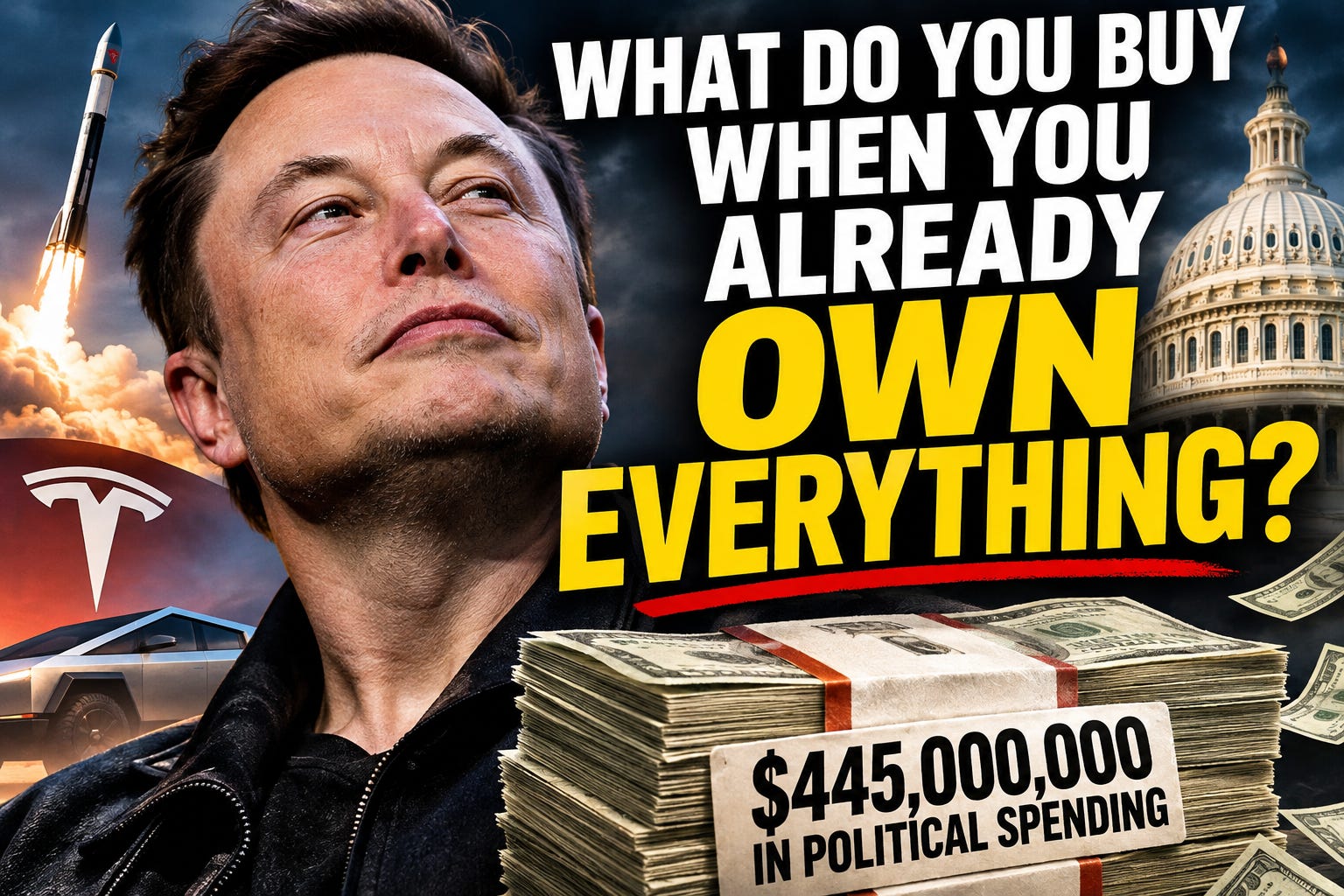
Because Musk recently spent nearly half a billion dollars attempting to influence the outcome of the 2026 midterm elections.
Half a billion dollars.
According to Reuters, his political spending totaled approximately $445 million on federal races alone, with additional spending through other political organizations and state-level campaigns.
The results were striking. According to Reuters’ November 5 reporting, just three of the 37 Republican House candidates Musk backed had won, while 33 had lost and one race remained uncalled. Six of the seven Senate candidates he supported had also lost, with the remaining race in Alaska still unresolved as of November 13.
And I found myself wondering something that had little to do with which party won.
What exactly was he hoping to accomplish?
What Was He Really Investing In?
Before going further, I think Musk deserves recognition for his accomplishments.
Tesla helped accelerate the adoption of electric vehicles. SpaceX transformed the economics of rocket launches. Starlink has brought internet connectivity to places traditional infrastructure struggled to reach. His willingness to challenge established industries has produced genuine technological progress.
These are meaningful contributions. And while his businesses have benefited from public contracts, subsidies, and government policies, that doesn’t negate the value they’ve created.
But political spending introduces a different set of questions.
According to reporting from Reuters and the Associated Press, Musk directed extraordinary sums toward Republican political organizations, including $158 million to the Senate Leadership Fund and substantial funding for his own America PAC.
Why those candidates?
One possibility is ideological. Musk has publicly expressed support for policies emphasizing reduced government intervention, individual freedom, and economic growth. He may genuinely believe Republican leadership offers the best path toward those goals.
Another possibility is commercial.
Tesla, SpaceX, Starlink, and his artificial intelligence ventures operate in industries profoundly affected by government decisions. Federal contracts, energy policy, tariffs, autonomous vehicle regulations, artificial intelligence oversight, and government investigations can all influence their prospects.
Reuters reported that Democrats were preparing to examine SpaceX’s government contracts and Musk’s previous government role. In that context, which party controls Congress has potential consequences for his business empire.
Consider Texas Governor Greg Abbott, whose reelection campaign Musk supported with at least $5.5 million in reported direct contributions. Under Abbott’s administration, Texas awarded SpaceX a $30 million grant for its planned Terafab semiconductor facility, while two local school districts advanced agreements for approximately $1.66 billion in proposed property-tax incentives for the project. The company also received a separate $17.3 million state grant in 2025 for an expansion of its Bastrop facility.
These arrangements have been promoted in the context of economic development, investment, and job creation.
And that’s where things become interesting.
Such incentives can genuinely benefit a community while also delivering enormous financial advantages to the companies receiving them. Musk may have supported Abbott because he believed his policies were good for Texas, because they were good for his businesses, or both.
We don’t have sufficient evidence to distinguish those motivations.
But isn’t that precisely the kind of relationship we should be examining? When someone contributes millions to a political candidate whose administration makes decisions affecting that person’s businesses, shouldn’t the public have a clear understanding of the financial interests involved and the benefits ultimately delivered?
That doesn’t prove Musk supported particular candidates to protect his financial interests. And it certainly doesn’t establish that any candidate agreed to provide favorable treatment in exchange for support.
But the overlap between his political investments and his commercial interests is worth examining.
What policies did these candidates advocate? Which would benefit his businesses? Which might benefit society more broadly, even where his companies stood to gain nothing?
Those are questions we should be asking of every major political donor, regardless of party.
Because political contributions can be motivated by principle, self-interest, or both. And without greater transparency, distinguishing between them is often difficult.
Imagine What Else Half a Billion Dollars Could Do
Here’s where I struggle most.
Imagine having $500 million available to spend on something that might improve the world.
Think about the clean drinking water that could be provided, the medical research that could be funded, the schools that could be improved, or the communities that could be lifted out of desperate circumstances.
To put that amount into perspective, $500 million could fund 10,000 projects costing $50,000 each. Whether those projects involved water infrastructure, educational resources, or community health initiatives, the possibilities are enormous.
Instead, hundreds of millions went toward political advertisements, campaign operations, and efforts to persuade people how to vote.
Now, I understand the counterargument. Political decisions can affect millions of people, and someone who genuinely believes a particular government will improve the country might reasonably consider political spending an investment in the public good.
A change in public policy could potentially accomplish far more than a collection of charitable projects. And political spending doesn’t simply vanish. It pays workers, organizers, media companies, and businesses.
So the question isn’t quite as simple as politics versus philanthropy.
But I keep coming back to the same thought.
Was this really the greatest good that money could accomplish?
Not just for Musk, but for anyone who has accumulated wealth beyond anything they could personally use.
And who gets to define what that greater good looks like?
What Happens When the Incentives Change?
Capitalism works remarkably well when its incentives align with human progress.
Invent something useful, build something better, solve a difficult problem, and the market rewards you. Those rewards encourage innovation, competition, and ideally, a higher standard of living for everyone.
At least, that’s the theory.
But capitalism doesn’t inherently reward the greatest contribution to humanity. It rewards what the market values, what people are willing to pay for, and what businesses can profitably provide.
Those things often overlap with human well-being, but not always.
A company can generate enormous profits while creating environmental damage. Another can develop a life-saving treatment that remains inaccessible to those who need it most. And a third can spend more money influencing government policy than improving its products.
None of these outcomes necessarily requires anyone to break the law.
They’re consequences of incentives.
And perhaps that’s where we should focus our attention.
If we reward the accumulation of capital above everything else, should we be surprised when people devote extraordinary energy toward accumulating and protecting it?
If political influence can improve a company’s competitive position, shouldn’t we expect businesses and wealthy individuals to pursue it?
The problem may not be that people are behaving irrationally or even unethically.
They may simply be responding to the incentives we’ve created.
And that raises a much larger question about what our economic system is actually designed to accomplish.
Maybe We’ve Been Measuring Success Wrong
I’ve written before about our seemingly endless desire for more. More money, more success, more recognition, more of whatever we’ve convinced ourselves will finally make us happy.
It’s something I also explore in my book, Everything Works. We have a remarkable tendency to reach a goal, barely acknowledge it, and immediately establish another one.
I’ve certainly been guilty of it.
But at some point, I began questioning what I was actually chasing.
Money, I realized, was never really the destination. It was a means of acquiring freedom. The freedom to travel, explore, spend time with people I love, pursue my interests, and live without constantly calculating what everything costs.
Once you begin thinking about money that way, the pursuit of endless accumulation starts to seem a little strange.
How much freedom does one person need?
And if you’ve already acquired more freedom than you could possibly use in several lifetimes, what exactly are you still trying to accomplish?
Perhaps the answer is to build something extraordinary. Perhaps it’s to leave a legacy, advance technology, or solve problems nobody else has managed to solve.
Or perhaps it’s simply to keep winning.
I don’t pretend to know what motivates Elon Musk, or anyone else with extraordinary wealth.
But I wonder whether the system we’ve created encourages people to ask the right questions once they’ve achieved financial success beyond anything they originally imagined.
What Is Wealth Ultimately For?
I don’t want to abolish capitalism. I want it to work better.
I want people who take risks, build companies, invent technologies, and improve our lives to be rewarded. I want innovation to flourish, competition to thrive, and individuals to have the opportunity to build meaningful financial independence.
But I also wonder whether we’ve become so focused on generating wealth that we’ve neglected to ask what we ultimately hope to accomplish with it.
Musk’s political spending is just one example. There are wealthy donors across the political spectrum who devote enormous resources to shaping public policy. Some may be motivated by genuine concern for society. Others may be protecting their interests. Many are probably motivated by some combination of the two.
And we shouldn’t assume that philanthropy is always more beneficial than political engagement, any more than we should assume political spending is necessarily an investment in the public good.
What matters is the outcome.
Did the money improve people’s lives? Did it advance something meaningful? Did it create opportunities, solve problems, or leave the world better than it was before?
Those seem like reasonable questions to ask, whether someone spends $500 or $500 million.
I’ve come to believe that money is most valuable not for what it allows us to accumulate, but for what it allows us to experience, create, and contribute.
Maybe that’s a lesson that becomes easier to appreciate with age. Or perhaps it takes a lifetime of chasing success to realize that success was never quite what we thought it was.
Either way, I keep returning to one uncomfortable question.
If you’ve already won the game of money, what would it take to start playing for something more meaningful?
Good ideas are worth sharing. If this article made you think, pass it along to someone who might appreciate a different perspective.
Enjoyed this article? Subscribe to Following the Thread for more perspectives on life, technology, and the world we’re creating. New essays delivered free to your inbox.