

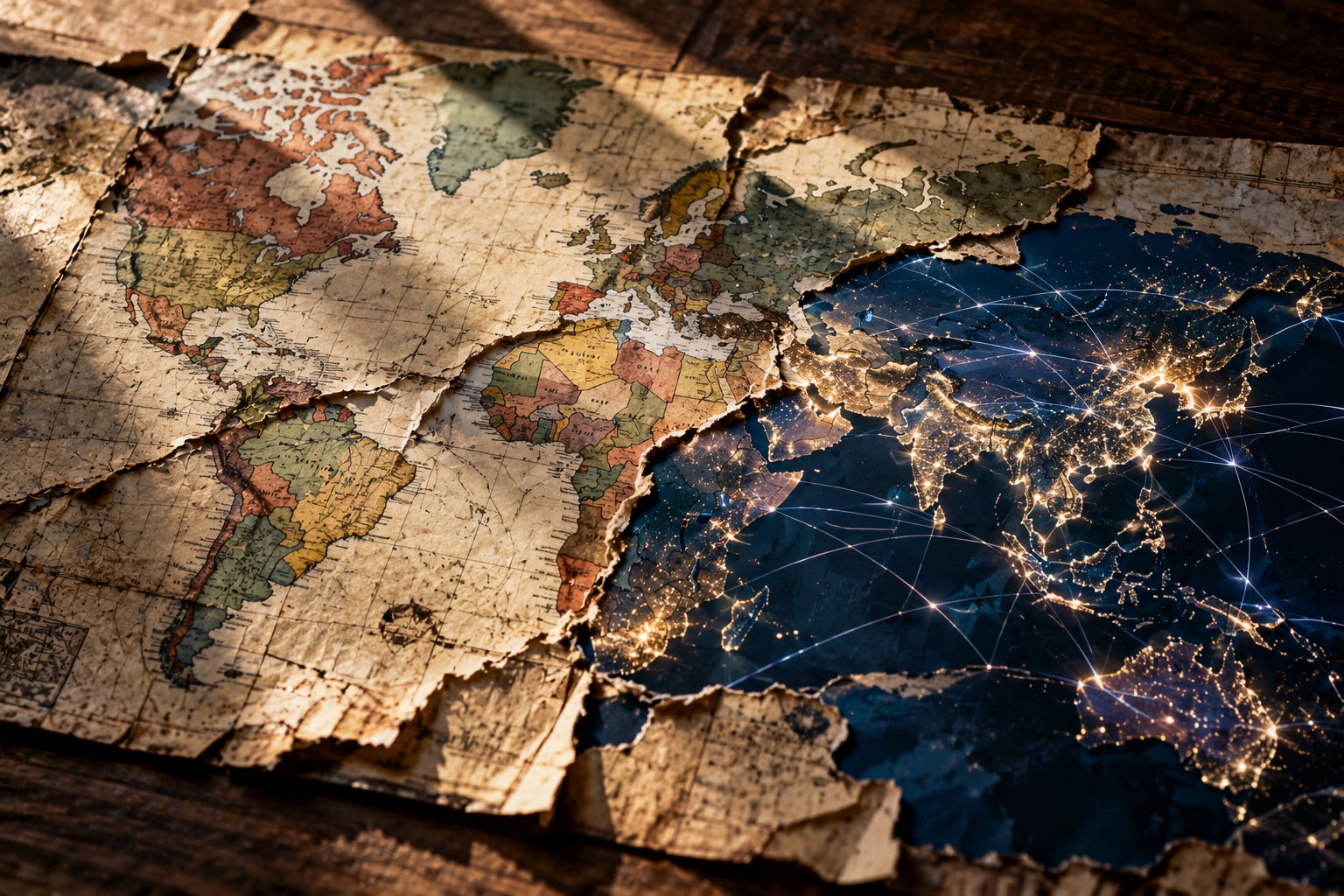
I was reading about China and Taiwan when I found myself stuck on a very simple question:
Why?
Not why does China want Taiwan. I understand the history. Civil war. Sovereignty. Territorial integrity. National identity. A century of competing claims compressed into words like reunification.
I mean: why are we still doing this?
Nearly 24 million people live in Taiwan today. They work, fall in love, raise children, build companies, vote, argue about politics, and plan what they’re doing this weekend. Almost none of them had anything to do with the Chinese Civil War.
Neither did almost anyone living in China.
Yet here we are, three generations later, contemplating the possibility that enormous numbers of living people could someday be asked to fight and die over an argument they inherited.
And Taiwan is hardly unique.
Look around the world and you begin to notice how much of civilization consists of inherited arguments.
Borders drawn by people who are dead.
Religious conflicts started by people who are dead.
Territorial claims based on governments that no longer exist.
National enemies inherited from our grandparents.
Political institutions designed for technologies, economies, and societies that would be almost unrecognizable today.
We inherit these things so completely that eventually we stop recognizing them as choices.
They become reality.
But reality keeps changing.
And something else has changed that I don’t think we fully appreciate yet: our ability to understand one another.
For most of human history, where you were born largely determined what you knew about the world. Your parents, teachers, community, religion, and government supplied much of the framework through which you understood it. Your language constrained what you could read. Geography constrained whom you could meet. Traveling halfway around the planet was something most humans would never experience.
Even curiosity had practical limits.
Imagine being sixteen years old in 1965 and wondering why Israelis and Palestinians both believed the same piece of land belonged to them. Or what life was actually like in China. Or why India and Pakistan hated each other. Or whether the version of history taught in your classroom was the same version being taught somewhere else.
You could ask someone. You could find a book. Maybe you had an exceptional teacher. Maybe someday you would travel there.
Or, much more likely, the question would simply pass.
That’s profoundly different from growing up today.
A curious teenager can wonder about something, pull a phone from their pocket, and have an answer in seconds. That answer can produce another question, which produces another answer, which produces another question.
Curiosity no longer has to wait.
And that matters because curiosity compounds.
One answer connects to another. History connects to economics. Economics connects to geography. Geography connects to religion. Religion connects to culture. Suddenly something that once looked like an incomprehensible conflict between strangers on the other side of the planet becomes a story involving actual human beings whose motivations, fears, and histories you can begin to understand.
The internet started collapsing that distance.
AI is collapsing it further.
Not because AI has the answers to humanity’s problems. It doesn’t. And not because having more information automatically makes people wiser. It clearly doesn’t.
What’s changing is the friction between curiosity and understanding.
A language you don’t speak is becoming less of a barrier. An academic subject you never studied is becoming less inaccessible. A perspective you’ve never encountered can be explored rather than merely dismissed. You can ask the stupid question, then the better question, then the uncomfortable question, without needing an appointment with an expert or worrying about revealing how little you know.
For someone whose brain is still forming its picture of the world, that is an extraordinary environment in which to grow up.
Previous generations didn’t have that advantage.
That isn’t an indictment of them. A person born in 1945 was no less intelligent or curious than someone born in 2005. But intelligence operates on the information available to it. Much of the worldview of older generations was formed when information was scarce, geography mattered enormously, cultures were comparatively isolated from one another, and challenging the accepted version of events required considerably more effort than opening another browser tab.
Those formative frameworks can persist long after the environment that produced them disappears.
And institutions persist even longer.
Governments, corporations, religions, political parties, and nations accumulate beliefs in much the same way people do. Eventually nobody remembers exactly why something must be done a particular way. There is simply a policy, a border, an alliance, an enemy, a tradition.
We inherited it.
So we continue it.
Perhaps this is one reason our technology can feel as though it belongs to the future while our politics so often feels trapped in the past.
We are becoming globally connected faster than our institutions are becoming globally minded.
A twenty-year-old today can play a video game with someone in Seoul, watch a Ukrainian describe her morning on social media, learn physics from an Indian professor, follow a Nigerian entrepreneur, translate a conversation with someone in Tokyo, and ask an AI to explain why China believes Taiwan belongs to it.
Borders remain politically powerful.
But they are becoming intellectually porous.
And perhaps that matters more than it initially appears.
Because once you understand people on the other side of a border, it becomes harder to reduce them to the abstractions necessary to sustain inherited conflicts.
They stop being the Chinese, the Russians, the Israelis, the Palestinians, the Americans.
They become people.
People who mostly want remarkably similar things: security, opportunity, dignity, family, some control over their lives, and the chance to leave their children something better.
None of this means history doesn’t matter.
It matters enormously.
Nor does it mean everything old should be discarded. Much of what previous generations built is extraordinary, and civilization depends upon accumulated knowledge.
But perhaps inheritance should come with an expiration date.
A border can have a history without having a destiny.
A grievance can be remembered without being reenacted.
A culture can preserve its identity without requiring another culture to surrender its own.
And a generation can respect the world it inherited without agreeing to keep running it exactly as it was handed to them.
Maybe the most consequential thing about our increasingly connected world isn’t that we’re finally able to know what everyone else thinks.
It’s that we’re becoming capable of asking something our ancestors rarely had the opportunity to ask:
If we were designing the world today, knowing what we know now, would we build it this way?
And if the answer is no, how long are the dead entitled to keep voting?